

Gioia del Colle, a renowned center of dairy production located about an hour from Casa Isabella, has very ancient origins. Inhabited since prehistoric times, little is known about its Roman and Early Medieval history, while the first documented records date back to 1085 during the Norman era.
The territory was greatly loved by Frederick II, who expanded the pre-existing Norman castle. After the Angevin and Aragonese periods, the fiefdom was incorporated into the powerful Acquaviva family of Conversano, until 1806, when the decree abolishing feudal rights was issued.
The Tourist Itinerary
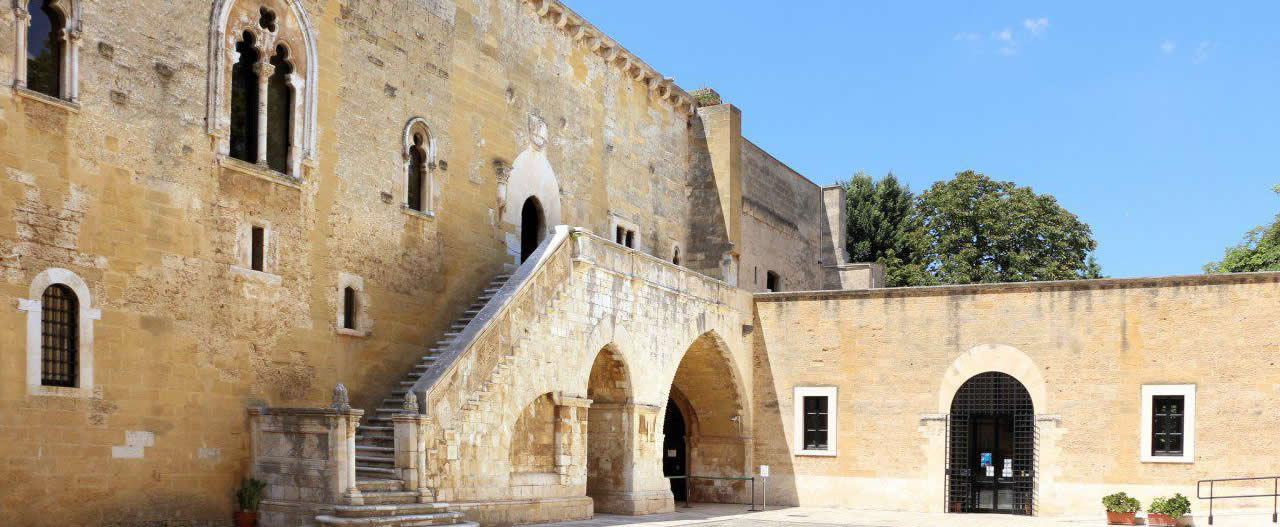
The Norman-Swabian Castle
One of the most beautiful castles in Puglia, built in 1087 by the Norman Richard Seneschal d’Hauteville and later modified by Frederick II of Swabia. Its façade is characterized by towering walls clad with protruding ashlars (bugne).The Municipal Theater
Built in 1841, when the town council decided to convert the old “Lamione,” a large hall of the former Dominican convent, into a theater.The Mother Church
After building the castle in 1087, Richard Seneschal also founded the Palatine Church of St. Peter (1150), replacing the ancient Church of San Marco. Later, it became known as the Church of Madonna della Neve.
The façade and bell tower were completed in 1893, as recorded on the church’s pediment.The National Archaeological Museum
A must-see is the Monte Sannace Archaeological Area, located 5 km from Gioia del Colle, in the heart of the Murgia Barese. The slopes of the hill were once occupied by a vast Peucetian settlement, a key link between the Adriatic and Ionian coasts. Today, visitors can admire the remains of dwellings, tombs, and four concentric defensive walls that once fortified the settlement.
